I think about a world to come where the books were found by the golden ones, written in pain, written in awe by a puzzled man who questioned, "What are we here for?" All the strangers came today and it looks as though they're here to stay.

-David Bowie "Oh! You Pretty Things"

Showing posts with label publication history. Show all posts

Friday, August 19, 2011

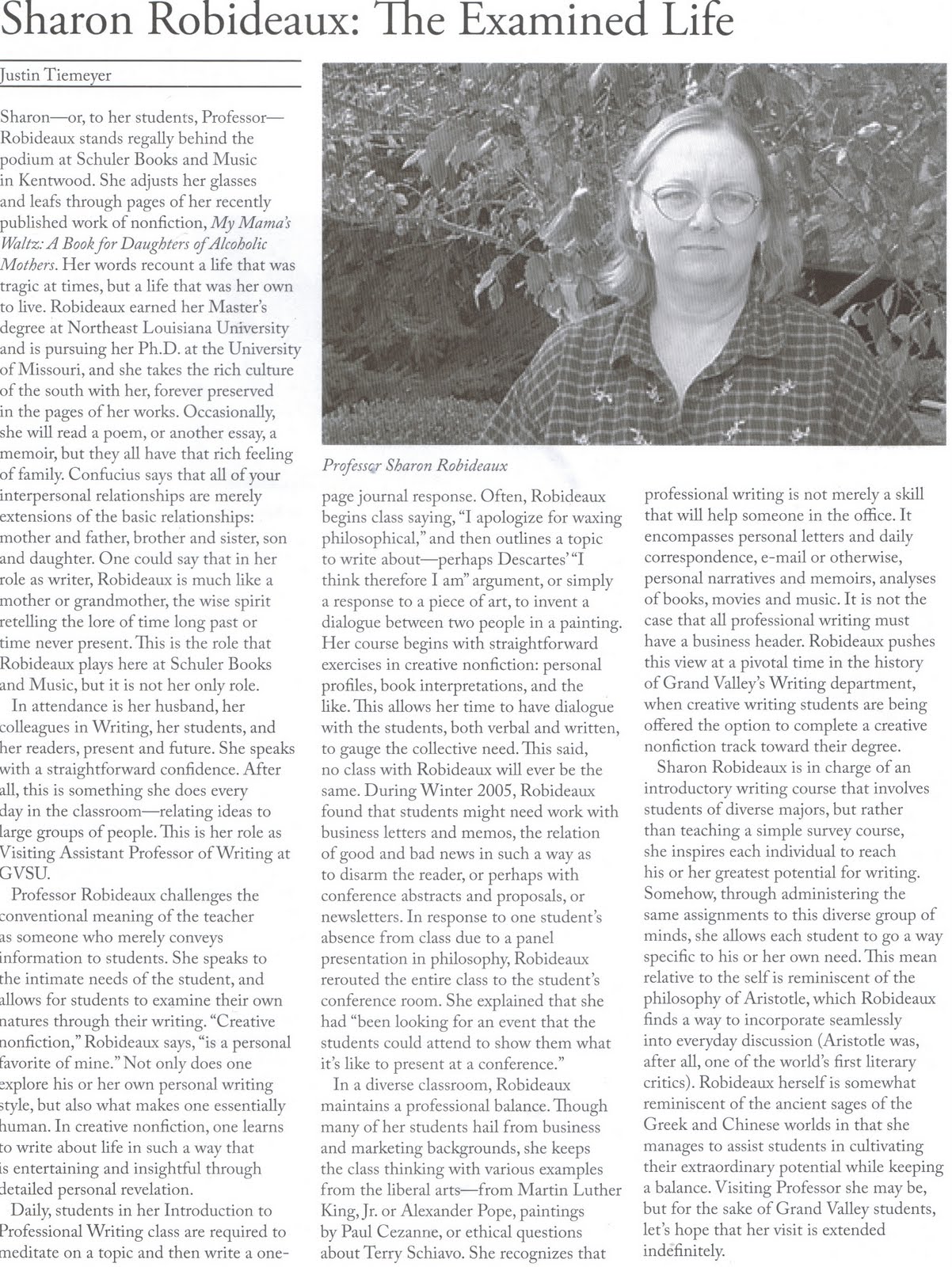
Publication History: Sharon Robideaux: The Examined Life

This is one of the couple of things I've had published that I am the least embarrassed about. The writing isn't terrible, but that's not what I'm talking about. The article I wrote for the Grand Valley State University magazine titled "Sharon Robideaux: The Examined Life" is one of my favorites because it was the right thing to do. Sharon Robideaux was one of my favorite writing professors that I ever studied with, but she wasn't a tenured faculty. When I wrote this piece, it was my intent to make a case that her Visiting Professor status should be renewed. The last sentence I wrote was, "Visiting Professor she may be, but for the sake of Grand Valley students, let's hope that her visit is extended indefinitely." When the article was published Professor Robideaux had already been let go from Grand Valley, so the article turned into my way of saying, "You did the wrong thing, Grand Valley. You should have renewed her contract."


I know it's either difficult or impossible to read the text on this file, but the original is accessible by simply clicking on the picture. If that is too small, then drop me a line and I can transcribe the file. Or don't read it. Depending on your interest.

Thursday, May 26, 2011

Publication History: Instincts

I'm much less embarrassed by the short story titled "Instincts" that I've included in my publication history. Sure, the story itself was lacking a lot of character development and plot, but there were some cool ideas and riffs in it, and I've always liked the style in which I wrote it. People compared my writing to my favorite authors at the time, Chuck Palahniuk and Bret Easton Ellis, assuring me that they did not mean it as an insult.

Below is a scan of a "broadside" featuring a passage from "Instincts," and a diagram of dog anatomy. Broadsides like these were made by Jason Rederstorf in limited quantities and used to promote the fledgling Student Reading Series at Grand Valley State University. Another copy of this very broadside hung framed in the hallways of the GVSU writing department for a year or so. Since it was made public in such a way, I consider it a publication. Of course, by that standard, a child's elementary school finger painting could be considered published once it lines the walls of said elementary school, and I have no problem listing myself amongst the great artists of elementary schools across the nation.

Thursday, March 24, 2011

Publication History: Achala Nabhastala (Unmoving Sky)

This is a particularly embarrassing inclusion in my publication history.

First, I am not a poet. I do not like to write poetry. When it comes to me writing poetry, I don't think there is any way to do it well. What convinced me that I should attempt to be a published poet, I will never know. It probably had a lot to do with being a moody teenager.

Second, I am fairly certain that I simply listened to the Pink Floyd song "Echoes" from the album Meddle. For the title, I was hoping to find something that sounded profound, so I used an on-line translator to change simple English words into exotic words from other languages. "Achala Nabhastala" is a really bad translation of the words "Unmoving Sky" into sanskrit using such a shady method.

Finally, this was published in a compilation of poems by The International Library of Poetry titled The Layers of Our Souls. If any of you have ever encountered The International Library of Poetry in your time, then you know that they will and do publish anything and everything. They do this in order to get those who have been published to buy their hard-cover anthologies. My family bought two copies of The Layers of Our Souls to celebrate my publication, but when I first opened my personal copy I noticed that regardless of how terrible my own poem was, nearly everything else in the anthology was even worse.

Because it couldn't possibly make you as sick to your stomach as it has made me, its author, I present to you "Achala Nabhastala (Unmoving Sky)" from The Layers of Our Souls (ISBN 0-7951-5055-5).

Tuesday, December 21, 2010

Publication History: Fugitives and Refugees Review


In 2005, I was back in school going for my second bachelor's degree, a writing degree with a creative writing emphasis. A professor of mine, Ander Monson, challenged us to widen our understanding of publication. I took this very seriously, writing a poem on a McDonalds bathroom wall, sneaking a non-fiction essay into Barnes and Nobles and Schuler Books. For this review, however, I did something sort of mundane: I published it on Amazon.com. If you don't believe I was published on such a cherished site, you can see for yourself here.

Portland's Finest (Well, Not Exactly)
Portland, Oregon.

For George Bush (senior) and Ronald Regan, greeted consistently with vomiting protestors, it was "Little Beirut."


For Chuck Palahniuk, author of Fugitives and Refugees: A Walk in Portland Oregon (Crown Publishers, 2003) this place is called home.


For Katherine Dunn, author of Geek Love, Portland is the likely destination of everyone who, looking for a new life, migrates west across America to the Pacific ocean. Why do they end up in Portland, Oregon? Because it's the cheapest place to live.


"We accumulate more and more strange people," she says. "All we are are the fugitives and refugees."


Palahniuk's aptly titled collection of short non-fiction speaks of oddballs and the things that make them tick. He speaks of what makes Portland, more than any other place, home.


Palahniuk is best known for his novels. Since his first bestseller, Fight Club, was made into a movie, Palahniuk has been the subject of a cult following. As a matter of fact, his web site is called the Cult (www.chuckpalahniuk.net). Since Fight Club, he has released a series of grotesque minimalist novels, including Choke, Lullaby, and Diary that delve into the strange: sex addicts, murder hymns, living statues, the works. Personally, I am a fan of Palahniuk's works. For me, he picks up where Joseph Conrad left off in Heart of Darkness, the exploration of the odd and why it is so appealing.


Fugitives and Refugees, though boasting with its name to tell only the stories of the grotesque, is actually something of a journey away from Palahniuk's normal style. While there are plenty of fun stories about strange people, the overwhelming feeling is that this place is home. "[W]hen you walk down the street, every corner has a story," Katherine Dunn says of Portland. "Here, the rolling history of your life is visible to you everywhere you look." This is the sentimental side of Palahniuk as he journeys through the past. It is an avant-garde travelogue mixed with the stories that Palahniuk has acquired on many street corners.


The book starts off slowly. From the interesting interview with author Katherine Dunn, fellow inhabitant of Portland, Palahniuk launches into descriptions of Portland terminology. This list of clever nick-names for places is entirely too long, and though I assume that these nicknames have acquired meaning through the years, they are entirely too contrived. Simple rhyming phrases. Nothing more, nothing less.


There are some interesting anecdotes that are definitely worth wading through the first part of the book for, for example, Palahniuk devouring a woman's scarf while on LSD at a Pink Floyd laser light show. It is not until the chapter entitled "Haunts: Where to Rub Elbows with the Dead" that this book picks up the pace and feels like a normal Palahniuk book. I read this chapter alone in my apartment, in the middle of the night. It is my opinion that Hollywood can produce nothing scarier than a true story. Thus, when Palahniuk writes non-fiction about the supposed haunting of much of Portland, it gets the adrenaline pumping. It keeps you awake, and willing yourself to read more - perhaps for the thrill, perhaps simply to read about something less frightening before you go to bed (like a later chapter on the sex industry entitled "Getting Off: How to Knock Off a Piece in Portland").


According to Palahniuk, the vast majority of Portland is haunted. He even interviews Bob and Renee Chamberlain, founders of Northwest Paranormal Investigations. "Renee and Bob say that something very basic about the Portland area, something organic, possibly the soil, allows spirits to manifest there more easily." This is when it hits you that this is not a normal travelogue. Palahniuk is telling stories about things that would keep most people away from Portland, but yet, this is the home of "the most cracked of the crackpots[, t]he misfits among misfits." This is a book that will help one set up an itinerary if, like Marlowe in Conrad's epic, one seeks that strange and irrational feeling in other people. More specifically, if one seeks that strange and irrational feeling in Portland, Oregon.


But then again, Palahniuk warns: "This book is not Portland, Oregon. At best, it's a series of moments with interesting people." More than that, this is a series of moments with interesting people, many of whom have effected Palahniuk in strange and profound ways. These are the people that fuel Palahniuk's fiction. He writes: "That's my job now, to assemble and reassemble the stories I hear until I can call them mine." Would I be jumping to conclusions to say that when I hear about Palahniuk's drug-addicted friends working for restaurants, I think about the members of Project Mayhem in Fight Club who add their own extra flavor to the New England clam chowder? Or that when I hear the story of Bob and Renee Chamberlain of the Northwest Paranormal Investigations, I think of the characters in Lullaby who have become completely desensitized to the haunting of their town? Palahniuk even mentions that the mausoleum at The Portland Memorial inspired his second novel Survivor, and even mentions that he wrote much of the novel while sitting in the mausoleum, "but the air is freezing and your fingers get stiff."


Fugitives and Refugees is the side of Palahniuk that any of his fans, of his Cult, must see. For newcomers and non-Palahniuk fans, this book is worth reading because it's short and satisfies the thirst for the gross and frightening, which at the same time is transposed into the entertaining and the delightful. For the writer, this is a sample of how one modern writer got started, from the moment he threw his tonsils from an apartment building wishing that he could be a writer to the moment his highly acclaimed first novel was made into a Brad Pitt movie.


And if you're planning to go to Portland any time soon, this book gives you the ingredients for one hell of an exciting trip through the city.

Tuesday, November 16, 2010

When They Were Cool: Eddie Murphy

In the 1980s, cool was still cool. In successive decades being uncool defined what was cool. Grunge made the high school loser into the heroic icon of cool. An anti-pop movement started, probably influenced by Radiohead's growing control of what is accepted as cool in music, and it was no longer cool to like anything on mainstream radio. By the turn of the Willennium, the heroes of the modern movie were incredibly skinny or incredibly overweight awkward boys who like eclectic music from the 70s and 80s like Michael Cera. If asked, "When was such and such cool?" the likely answer is, "the 80s." Some have posited that this is related to the death of Miles Davis, the inventor of Cool, in 1991.

Eddie Murphy used to be cool. What? You don't remember him ever being cool? Well, he sure was. When?

Pay attention. The answer is the 80s.

Murphy's appearances on Saturday Night Live and his comedy special Delirious (1983) made him into an overnight sensation, and quite frankly, his influence on the acceptance of blacks in show business is probably largely overlooked. In a world without Richard Pryor, one might even go so far as to say that Murphy is the most important black figure in comedy movies, commanding America and setting the tone of comedy to follow. That's something that you can't take away from Murphy. Unfortunately, Murphy is not allowed to rest on his laurels. You have to keep performing. Eddie Murphy is important, but he sure isn't cool anymore.

In the 80s Eddie Murphy talked about flatulence, and it was cool. He didn't call it farts. He said "fahts." And it was cool. He was homophobic. He wasn't politically correct. He's probably part of the reason that everyone became so hyper-PC in the 90s. But regardless of what you think about this, he made it cool. And that made things difficult for 90s politicians. Murphy also had glorious teeth and an impressive body, so women loved him. And women loving you makes you cool.

Maybe you disagree. Here's an indisputable proof. The Golden Child and Coming to America. You don't get it yet? IN The Golden Child (1986) Eddie Murphy and a little boy get chased by a giant flying demon. A GIANT FLYING DEMON! In Coming to America (1988) Murphy is a king from an African nation who really doesn't get American customs. He's basically a wealthy black version of Uncle Travelling Matt from Fraggle Rock. Many of his films are even socially aware and sensitive to ideas of class and race, especially Trading Places (actually, that movie may just be about Jamie Lee Curtis's breasts... Can you remember anything else about Trading Places? Hmmm...).

 A decisive end to Eddie Murphy's coolness is not completely clear. Remember that Miles Davis died in 1991, so it must have been pretty close to that time. Tom Cruise survived until 1992 as a cool dude, after all, so its possible to be cool in a world without Cool. Murphy's dignity was certainly gone by the time he did Nutty Professor (1996). The combination of putting on a fat suit and playing multiple characters is the epitome of lame comedy, a fact that some people really don't understand (ahem... Martin Lawrence... Tyler Perry...).

This article ought not to end on a negative note. After all, its very possible that Murphy passed the torch of coolness to Will Smith. In 1990, the Fresh Prince of Bel Air premiered on NBC. As we all well know, Fresh Prince set Will Smith up for Blockbuster Independence Day films, and these films set us up for the Willennium. It's Thanksgiving, so let's be thankful for all that Eddie Murphy has given us, thankful for the dude who hasn't been cool for two decades.
Wednesday, November 10, 2010

The Willennium So Far - 2009

In the mid- to late-nineties one of the most important American cultural traditions was the Fourth of July Will Smith blockbuster. The tradition had a proper beginning with the film Independence Day in 1996 in which Will Smith saves the world from aliens and says such profound lines as "I have GOT to get me one of THESE!" and "No, you did NOT shoot that green [expletive deleted] at me!" This was followed the next year by Men in Black in which Will Smith saves... the world... from aliens... (Author's note: it feels like I wrote this sentence already...) and then in 1999 by Wild Wild West. These latter two movies are significant because of Smith's musical contributions. For Men in Black, Smith wrote the hip hop song "Men in Black" which features a sample of Patrice Rushen's funk standard "Forget Me Nots" that Smith raps over. In the song "Wild Wild West," written for the movie Wild Wild West, Smith samples the Stevie Wonder tune "I Wish."

As a result of the popular tradition of Will Smith blockbusters with songs of the same name featuring easily recognizable funk and soul samples, Smith found himself on a particularly influential platform. On November 16, 1999, Smith released the album Willennium. With the combination of the Y2K hysteria, blockbuster success and the propaganda off of his album, Will Smith declared the coming millennium to be the Willennium. Such are the days that we currently live in.

Though the Fourth of July Will Smith blockbuster trend has continued with such films as Men in Black II (2002) and Hancock (2008), the first decade of the Willennium has not been what the world expected a Willennium to look like. These films didn't see the magnitude of success and popular culture following that their predecessors had, and the huge spacing between them makes one feel that the tradition may be coming to an end. Furthermore, Smith has been featured in enough "serious" films (The Pursuit of Happyness, Seven Pounds) that Hollywood production companies appear to simply make scrips that would work for Will Smith to be in. In other words, Will Smith no longer plays roles or characters in movies; rather, movies are built around the personality that is Will Smith.

There is also the unfortunate possibility that Will Smith is Satan, which compounds the difficulties of the Willennium. Revelation 20:7-8 says, "When the thousand years are ended, Satan will be released from his prison and will come out to deceive the nations at the four corners of the earth, Gog and Magog, in order tog ather them for battle; they are as numerous as the sands of the sea." What this would suggest is that Satan Will Smith was released into a position of power at the end of the previous millennium, and that his unification of all mankind under the sign of the Willennium is a means of bringing about a strife-filled end-times. Gog and Magog might here be understood as producer DJ Jazzy Jeff and label Columbia Records.

The evidence, however, to conclude that Will Smith is Satan is somewhat unconvincing. Your beloved Fort Worth Movie Examiner would like to suggest that there is hope yet in this Willennium we are witnessing, that there is still room for the courage of the human spirit, for men and women who stand up against the evil aliens and robots and protect this great planet. That, after all, is what Will Smith has always stood for, and by proxy, that is what the Willennium stands for. Though our parents just don't understand this Willennium, it is not theirs to understand. It belongs to us and to our progeny. Perhaps Will Smith was a little big for his britches when he declared this millennium to belong to him. That is not the issue under scrutiny. The issue is fulfilling the potential of the Willennium, making this thousand years the best possible thousand years.

...unless Will Smith is actually the devil, in which case let's just try to survive.

Tuesday, November 9, 2010

When They Were Cool: Tom Cruise

You used to be all right. What happened? - Radiohead


Tom Cruise used to be cool. Now he's not. As a matter of fact Tom Cruise hasn't been cool for a long time. You may have seen recent movies where Cruise was entertaining. Maybe he was even brilliant. One thing's certain: he certainly wasn't cool.

Enough negativity. This is not an anti-Tom Cruise article, but a celebration of those glorious days when Tom Cruise was cool. It is a time for joy and gaiety.

Tom Cruise's career can be summed up in three distinct phases. The first phase fits roughly to the span of the 1980s and is defined by Tom Cruise being way cool. This leads to the second phase during the 1990s where, as a result of Cruise's coolness, his sex life becomes more important than his film career. Days of Thunder and Far and Away were sweet, but his introduction to actress and future wife Nicole Kidman spelled the beginning of the end for his coolness. The final phase corresponds with the most recent decade, a period where Cruise's sex life, which should be considered at its peak with young beauty Katie Holmes, is eclipsed by his loony support of the Church of Scientology.

Remember when Tom Cruise was cool? Of course you do, but let me remind you anyways:


The movie is Risky Business. Tom Cruise plays Joel Goodson. He wears sunglasses. Already he's way cooler than Ferris Bueller. He sleeps with Lana, played by Rebecca De Mornay. He parks his father's Porsche in Lake Michigan. He dances in socks to the tune of Bob Seger's "Old Time Rock and Roll"...

The movie is Top Gun. Tom Cruise plays Maverick. He pilots a F-14A Tomcat. He wears sunglasses and has the need, the need for speed. He's lost that loving feeling. He plays with the boys. His breath is taken away multiple times by Charlotte Blackwood (Kelly McGillis), who he sleeps with...

The movie is Days of Thunder. Tom Cruise plays NASCAR driver Cole Trickle. He drives fast. He drafts behind other cars. He drives a toy car up the thigh of Dr. Claire Lewicki (played by Nicole Kidman) and he sleeps with her. He wears sunglasses...


These are unforgettable characters in scene after unforgettable scene of a series of unforgettable movies. The era of Tom Cruise's coolness has been over for nearly two decades, but lucky for us some evidence of that era still remains. Let us join together in watching the following movies in celebration of coolness: 

Endless Love (1981)
Taps (1981)
The Outsiders (1983)
Losin' It (1983)
Risky Business (1983)
All the Right Moves (1983)
Legend (1985)
Top Gun (1986)
The Color of Money (1986)
Cocktail (1988)
Rain Man (1988)
Born on the Fourth of July (1989)
Days of Thunder (1990)
Far and Away (1992)
A Few Good Men (1992)

The Justin/Jeff Project: Death Wish (1974)

In the spirit of the Julie/Julia project in which writer Julie Powell chronicles cooking all of the recipes in Julia Child's Mastering the Art of French Cooking, 524 recipes in 365 days, I bring you the Jeff/Justin project. The Justin/Jeff project chronicles my descent into the filmography of Jeff Goldblum and will take as much time as it takes.

If you were born in time to experience the 1990s you are likely to adore Jeff Goldblum with a fiery passion. Few films are more quotable than his 1993 film Jurassic Park, and few actors can pull off long pauses and verbal junk ("Uhhhhh") better than Jeff Goldblum. Jeff Goldblum is to 90s cinema what the Teenage Mutant Ninja Turtles are to 90s television. Of course, the TMNT film trilogy complicates this analogy, but that's not important right now.

What is important is Jeff Goldblum's cinematic excellence. The strongest of rivers often begins as a trickling mountain stream, and so too with Jeff Goldblum, whose first cinematic role is a character named Freak #1 in the 1974 Charles Bronson revenge flick Death Wish.

Freak #1 is one of three disturbed twenty-somethings who run around New York City looking for trouble. Viewers are lead to believe that the three freaks are capable of horrendous acts of carnage by the uncivilized manner in which they knock items off of shelves and eat snacks they haven't paid for at the super market. Shock! Menace! They are like velociraptors hunting in a pack formation.

Another similarity between the three freaks and velociraptors is that they all know how to open doors, which leads to the beginning of the movie's revenge theme. Freak #1 and his posse assault two women named Joanne Kersey and Carol Anne Toby in their own home after getting their address from a grocery store delivery slip. The whole crime is perpetrated with the use of their amazing door-opening skills.

In the aftermath, Carol Anne is comatose. Joanne dies. The family's partriarch Paul Kersey goes on a criminal hunt. All this and the fate of Freak #1 is never revealed. I imagine that Kersey's highly publicized vigilante justice scares Freak #1 off the streets. He cleans up and goes back to school where he studies criminal justice or city-planning and goes on to make New York City a better place. Maybe there's a Mrs. Freak and some little freaky children. He does all of this in the name of the Kersey family.

Why this optimism? Because Jeff Goldblum is a better man than Freak #1. He stands up for a dinosaur's right not to be cloned (Jurassic Park). He stands up for Earth's right not to be destroyed by alien death rays (Independence Day). This is why Freak #1 becomes a pillar of his community in the off-camera future of Death Wish.

Thursday, September 30, 2010

Publication History: X-Mail

My publication history is pretty sad. This first piece is a letter I wrote that was published in the X-Mail column in the back of Uncanny X-Men #336. The publication date of September, 1996, would mean that I was only thirteen years old at the time. The best adjective I could think of to describe this letter is inane, and I think that the bold-lettered response from the editor reflects this pretty well.

Feel free to construct your own opinion. Here is my letter that was published in X-Mail in 1996:


I have some digging to do before I can reveal to you more of my publication history. Until then, try not to feel too bad. According to mathematics, there's a probability that even a randomized series of letters, numbers and punctuations could form a best-selling novel. So there's hope for me yet, nyet?