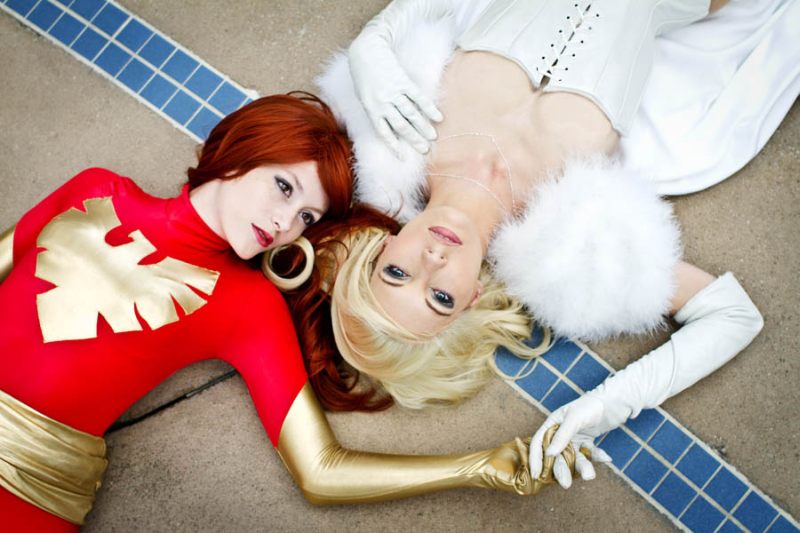
Most of these cosplayers unveiled their fantastic female X-Men costumes at Dragon Con 2011. It ought to be noted, however, that Storm's costume was unveiled at Anime Expo 2011. While I do enjoy anime, I love it when my good old fashioned comic book characters can make a showing even more. Here are the costumes.
I think about a world to come where the books were found by the golden ones, written in pain, written in awe by a puzzled man who questioned, "What are we here for?" All the strangers came today and it looks as though they're here to stay.
-David Bowie "Oh! You Pretty Things"
Showing posts with label jean grey. Show all posts
Saturday, October 8, 2011
Friday, September 30, 2011
My Favorite Marvel: Jean Grey
If there is one person who really has his act together in the Marvel universe it is Mr. Sinister. I don't mean that he has his act together in that he's fighting for the right cause or doing anything good in any way. I mean that he just has the best taste in mutants. Mr. Sinister has been obsessed for hundreds of years with the bloodlines of Scott Summers and Jean Grey, and they just happen to be two of my absolute favorite characters in the Marvel universe. For that, Sinister ought to be applauded. He's like a foodie, only with individuals who have genetic mutations that give them amazing and terrible powers. For all the other stuff, Sinister can go... Well, I'm sure you know what he can do with himself.
If I had begun my X-Men experience as a child reading X-Men #1 and continuing throughout the various X-comics, I think my first love would have been Jean Grey. (As it was, my first X-Men experience involved watching X-Men: The Animated Series, and my first love was Rogue. Or was that my first lust? When you're young and being burned alive with testosterone those boundaries can be confusing.) Jean Grey was much like many of my real-life first loves for the boys of the original X-Men team. Many of them had never been noticed by a girl before, much less one so beautiful, and though they were constantly racked with doubt - I'm talking mostly about Scott Summers now, but I'm sure the others had their moments - Jean Grey made them feel really good about themselves when she was there and made them miss her when she was gone.
There was never a better use of thought bubbles than when Jean Grey wondered whether Scott Summers loved her and when Scott Summers wondered whether Jean Grey loved him. Maybe this is the side of me who really adored the first couple of seasons of Dawson's Creek, but the added brilliance of the X-Men comics was that Jean Grey would develop the ability to connect those thought bubbles, to bridge the gap between thought and speech. Originally, her mutant ability was limited to telekinesis, and later she was given a degree of Professor Charles Xavier's telepathy. (Of course, I think that post-Phoenix this was retconned, but I'm not sure about this. The way I imagine the story has something to do with how the X-Men movies told Jean Grey's story. When she was young she was haunted by voices and her amazing power, amped up by a confusing and unknown force that would later be revealed to be the Phoenix force. When Xavier encountered her, he was forced to hide these powers behind a psychic wall. Thus, when Xavier gave her a degree of his telepathy, I imagine that to actually be Xavier tearing down part of that wall, perhaps the part that could have kept the Phoenix from taking over...) With the power of telepathy, one of the most romantic concepts ever conceived came into being, the psychic rapport between the lovers Jean Grey and Scott Summers. Because of their commitment and love, their thoughts would never be separated, regardless of distance and any other intervening factor short of death.
Now, much of this has been my understanding of Jean Grey through ruby-quartz glasses. But there is something about Jean Grey outside of Scott Summers' perception of her that is fantastic. For one, she's possibly the most powerful mutant of all time. But like Superman, her power is accompanied by a great deal of personal strength, of will. The first appearance of the Phoenix power manifested itself in Jean Grey when she was piloting a doomed space craft to Earth. Though there were others who were better pilots, others who were more manly, she sacrificed herself for the sake of the safety of the others. And through this sacrifice we were introduced to the Phoenix force for the first time. It was this show of great strength that brought Jean Grey strength beyond imagination. Once the Phoenix force was established, Jean Grey showed us what we should have been learning from over-powered DC characters for years, that immense power is tempting and terrifying, that it will drive you mad, that you will spend all of your life trying to keep this power under control.
Though Jean Grey represents acceptance, love, power, courage and strength of character, I think the most important thing about her is that she represents life. From the beginning, Jean Grey was the green-eyed lady, and while some associate green eyes with greed, there has always been a kind of folk myth about the ephemeral green-eyed lady, the ones who come and go from your life. Jean Grey is fleeting like life. Once you got used to her being around, she went off to college. Once you got used to her being around again she died. Once you got used to her being around, she died again. I guess it is a little depressing, but then again, so is death. On the flipside, however, let's not forget that one can also encounter acceptance, love, power, courage and strength of character in life. It may not last forever, but it is full of great beauty. Such is the myth of the green-eyed lady. Such is the myth of the Phoenix.
And such is the myth of Jean Grey. Whether you're calling her Jean or Marvel Girl or Phoenix or Red, Jean Grey is simply one of the best characters ever created.
Friday, September 23, 2011
Superheroes, Cheating and Resurrection
My good friend Arthur over at Arthur the Lesser wrote a comic book related post titled "A Little Less Bright" on his non-comic book blog recently, and it deals with the idea of death and resurrection in comic books. He details that there are some characters who are dead, and who must remain dead for the sake of the story and lists Uncle Ben, Bucky Barnes, Gwen Stacey, and Barry Allen as his examples. Aside from characters such as these and characters who don't really matter (thank goodness there are no such thing as people who don't really matter in the real world), there's a high likelihood that a character is going to come back from the dead. He then cites a series of comic book characters who have come back from the dead (sometimes despite being on the don't touch list) - Bucky Barnes, Jason Todd, May Parker, Green Arrow, Green Lantern, Flash, Aquaman and Martian Manhunter - and this list is nowhere near exhaustive.
Arthur's post was really about a boy in the real world who was dying of cancer. His last wish was to be a superhero, so he died a superhero. His name was Electron Boy, but the people close to him knew him as Erik Martin. Erik Martin's story is important, and as close as we may get to our comic book heroes they will never be as real as Erik Martin was when he was alive, as he is in the hearts and minds of those who were able to be a part of his life. I do not wish to disrespect Erik, but I really want to focus on another ethical issue, so let us shift now from the fact that heroes like Electron Boy don't get to come back to life and rejoin their families, at least not in "this life," to the fact that the unwritten code for what one must do when a loved one dies must be re-written in a world where the people who surround you consistently come back from the dead. I'm not talking about zombies. I'm talking about your beloved wife coming back from the dead if you're Cyclops and your wife is Jean Grey. I'm talking about your aunt coming back from the dead if you're Spider-man and May Parker is your aunt.
The focus of this post is a discussion that I was a part of on a comic book web site called Comic Vine. The message board topic was about how Cyclops cheated on Jean Grey. I started writing on what has happened during the numerous times when Jean Grey was dead and Cyclops tried to move on with his life. In fact, I argued, it would be much easier to say that Cyclops cheated on Madelyne Pryor with Jean Grey than that he cheated on Jean Grey with anyone else. Of course, I was way off topic. It seems that they were talking about how, during the Grant Morrison run, Cyclops telepathically cheated on Jean Grey with Emma Frost and the ethical implications. (Is it really cheating if it's all mental?) And I think that's why I'm focusing on the other side of the discussion here. Yes, Jean Grey was dead and Cyclops was trying to move on. He dated Aleytys Forrester, the daughter of a ship captain, after she died and then he married Madelyne Pryor and had a very important child with her. (But, let's face it, Cyclops had proposed to Jean Grey, a woman who was then going by the name of Phoenix. We'd already seen death and rebirth by that time and her name was Phoenix. He had to - and I believe he did - know that she was going to come back.) But when Jean came back he left his wife and child and everyone seemed to be okay with it because we believed that they were meant to be.
Is there a new rule in comic books that if your true love comes back from the dead your responsibility belongs to that person alone? I can't help but to think of the movie Castaway, where FedEx executive Chuck Noland returns from a deserted island, only to find that he was believed dead and that his true love has moved on with her life. In the end, Chuck Noland simply has to find another way, another love. But Cyclops returns to Jean Grey. Now, nothing of this new rule excuses Cyclops from wrongdoing. It's more like the daughters of Henry VIII, Mary and Elizabeth: If Roman Catholicism is true then Mary is the true-born daughter and Elizabeth is a bastard; If Protestantism is true then Elizabeth is the true-born daughter and Mary is a bastard. No matter how you look at it, someone's a bastard. The same is true for Cyclops, only he is the bad guy in both cases. If the normal rules of society, marriage and the unwritten rules of love hold true, then he cheated on Madelyne Pryor when Jean Grey returned to life. But if there is some comic book clause regarding resurrection then he should have waited for Jean Grey and marrying Madelyne Pryor was the act of cheating. In all likelihood, however, both are a kind of cheating.
I know there are some people who think this is ridiculous. But I want you to think about this. Some of you don't have to think too hard: you've already had this experience. You have loved someone very deeply and then you have lost that person. It took years, but you found the courage to move on with your life, to love someone else, because that's what the other person would have wanted. Now, imagine you live in a universe where you experience the return of lost friends and enemies quite often. You might not have any reason to be certain that your lost loved one will return to life, but the chance alone seems to warrant a different way of acting, a different unwritten law of love. Some will live forever without taking another significant other, simply because of love, because of an impossible belief that you might once again share a bed. Some think this is crazy. I really don't. The way I love Amy, I can't imagine ever being able to love someone else again. But if Amy passed and there was a real hope, maybe a one in three chance, that she'd be returned to me in a few years, that impossible hope would be possible, maybe even probable. And if, in that time, I took on another significant other, I would consider myself the most wretched of the wretched.
It makes me want to write letters. Dear Kitty Pryde, you say Colossus died? Just wait longer. Dear Colossus, you say Kitty Pryde is no longer with us? Have hope. She shall return. Dear Cyclops, you say Jean Grey is dead? Again? The Phoenix will probably return like she did last time. Dear Black Canary, has your beloved Green Arrow left you? Just wait longer. Dear Lois Lane, has your protector fallen? He's effing Superman. Do you really think he can die? Without being insensitive, I want to tell these people in the world of abundant resurrection that they need to stay true to the people that they love. They do not have the choice to move on. A death is not a kind of breaking up. Because when they come back, they still often act as if nothing has changed. As should you, the living of the comic book world. Our lost loved ones aren't returned to us in "this life," but yours often are. Find a way to be true to them. Don't just hook up with the blonde who wears lingerie all the time, reads minds, and turns to diamond.
Arthur's post was really about a boy in the real world who was dying of cancer. His last wish was to be a superhero, so he died a superhero. His name was Electron Boy, but the people close to him knew him as Erik Martin. Erik Martin's story is important, and as close as we may get to our comic book heroes they will never be as real as Erik Martin was when he was alive, as he is in the hearts and minds of those who were able to be a part of his life. I do not wish to disrespect Erik, but I really want to focus on another ethical issue, so let us shift now from the fact that heroes like Electron Boy don't get to come back to life and rejoin their families, at least not in "this life," to the fact that the unwritten code for what one must do when a loved one dies must be re-written in a world where the people who surround you consistently come back from the dead. I'm not talking about zombies. I'm talking about your beloved wife coming back from the dead if you're Cyclops and your wife is Jean Grey. I'm talking about your aunt coming back from the dead if you're Spider-man and May Parker is your aunt.
The focus of this post is a discussion that I was a part of on a comic book web site called Comic Vine. The message board topic was about how Cyclops cheated on Jean Grey. I started writing on what has happened during the numerous times when Jean Grey was dead and Cyclops tried to move on with his life. In fact, I argued, it would be much easier to say that Cyclops cheated on Madelyne Pryor with Jean Grey than that he cheated on Jean Grey with anyone else. Of course, I was way off topic. It seems that they were talking about how, during the Grant Morrison run, Cyclops telepathically cheated on Jean Grey with Emma Frost and the ethical implications. (Is it really cheating if it's all mental?) And I think that's why I'm focusing on the other side of the discussion here. Yes, Jean Grey was dead and Cyclops was trying to move on. He dated Aleytys Forrester, the daughter of a ship captain, after she died and then he married Madelyne Pryor and had a very important child with her. (But, let's face it, Cyclops had proposed to Jean Grey, a woman who was then going by the name of Phoenix. We'd already seen death and rebirth by that time and her name was Phoenix. He had to - and I believe he did - know that she was going to come back.) But when Jean came back he left his wife and child and everyone seemed to be okay with it because we believed that they were meant to be.
Is there a new rule in comic books that if your true love comes back from the dead your responsibility belongs to that person alone? I can't help but to think of the movie Castaway, where FedEx executive Chuck Noland returns from a deserted island, only to find that he was believed dead and that his true love has moved on with her life. In the end, Chuck Noland simply has to find another way, another love. But Cyclops returns to Jean Grey. Now, nothing of this new rule excuses Cyclops from wrongdoing. It's more like the daughters of Henry VIII, Mary and Elizabeth: If Roman Catholicism is true then Mary is the true-born daughter and Elizabeth is a bastard; If Protestantism is true then Elizabeth is the true-born daughter and Mary is a bastard. No matter how you look at it, someone's a bastard. The same is true for Cyclops, only he is the bad guy in both cases. If the normal rules of society, marriage and the unwritten rules of love hold true, then he cheated on Madelyne Pryor when Jean Grey returned to life. But if there is some comic book clause regarding resurrection then he should have waited for Jean Grey and marrying Madelyne Pryor was the act of cheating. In all likelihood, however, both are a kind of cheating.
I know there are some people who think this is ridiculous. But I want you to think about this. Some of you don't have to think too hard: you've already had this experience. You have loved someone very deeply and then you have lost that person. It took years, but you found the courage to move on with your life, to love someone else, because that's what the other person would have wanted. Now, imagine you live in a universe where you experience the return of lost friends and enemies quite often. You might not have any reason to be certain that your lost loved one will return to life, but the chance alone seems to warrant a different way of acting, a different unwritten law of love. Some will live forever without taking another significant other, simply because of love, because of an impossible belief that you might once again share a bed. Some think this is crazy. I really don't. The way I love Amy, I can't imagine ever being able to love someone else again. But if Amy passed and there was a real hope, maybe a one in three chance, that she'd be returned to me in a few years, that impossible hope would be possible, maybe even probable. And if, in that time, I took on another significant other, I would consider myself the most wretched of the wretched.It makes me want to write letters. Dear Kitty Pryde, you say Colossus died? Just wait longer. Dear Colossus, you say Kitty Pryde is no longer with us? Have hope. She shall return. Dear Cyclops, you say Jean Grey is dead? Again? The Phoenix will probably return like she did last time. Dear Black Canary, has your beloved Green Arrow left you? Just wait longer. Dear Lois Lane, has your protector fallen? He's effing Superman. Do you really think he can die? Without being insensitive, I want to tell these people in the world of abundant resurrection that they need to stay true to the people that they love. They do not have the choice to move on. A death is not a kind of breaking up. Because when they come back, they still often act as if nothing has changed. As should you, the living of the comic book world. Our lost loved ones aren't returned to us in "this life," but yours often are. Find a way to be true to them. Don't just hook up with the blonde who wears lingerie all the time, reads minds, and turns to diamond.
Labels:
cheating,
comic books,
cyclops,
dc,
death,
jean grey,
marvel,
resurrection
Subscribe to:
Posts (Atom)